

Safety Comes Before Self-Actualization at Work

We all want high-performing, motivated teams. Every HR pro wants to foster a culture where employees are engaged, strategic, and self-directed. And every CEO dreams of employees who “act like a VP before they become one.” We want employees to bring their whole selves to work, collaborate with purpose, contribute innovative ideas, and chase growth with passion.
But what if, despite offering learning opportunities, career paths, and even a culture of inclusion, people still seem disengaged, anxious, or withdrawn?
Here’s the truth. You can’t expect self-actualization from someone stuck in survival.
To understand why, we need to revisit a foundational concept in human psychology: Maslow’s Hierarchy of Needs.
The Foundation of Motivation Is Safety
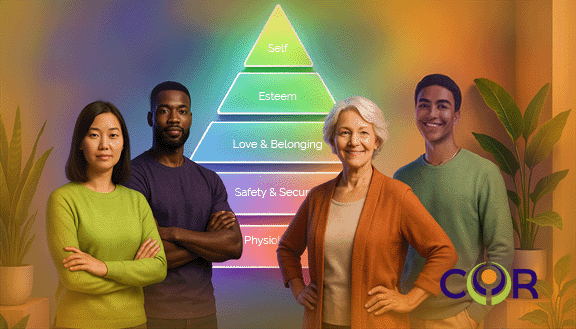
Maslow’s model of human motivation is built like a pyramid. At the base are physiological needs, things like food, rest, and shelter. Just above that comes safety and security, physical and psychological. Only once these are met can individuals move on to seek belonging, esteem, and self-actualization. These are the layers where purpose, passion, and peak performance live.
You can’t skip the lower levels.
Physiological Needs
These are the basics: food, water, sleep, housing, and physical well-being.
Workplace impact: Employees who are working multiple jobs to afford rent, skipping meals to make ends meet, or suffering from sleep loss due to chronic stress are not in a state to “focus on innovation” or “bring their best selves to work.” They’re focused on surviving.
Safety and Security
This includes physical safety, job security, financial stability, and legal protection.
Workplace impact: Concerns over layoffs, wage stagnation, I.C.E. raids, expired work permits, unaffordable healthcare, or rising inflation create a sense of instability. If an employee doesn’t feel safe—whether physically, emotionally, or legally—they cannot move forward to belonging or growth.
Love and Belonging
Humans need connection: to be seen, valued, and included.
Workplace impact: A lack of inclusion, cliques, poor management, or microaggressions can leave people isolated. Without psychological safety and a sense of belonging, employees may withdraw, disengage, or burnout—long before you ever see it on a performance review.
Esteem
This includes confidence, recognition, respect, and the belief that you matter.
Workplace impact: If employees don’t see people like them in leadership, or promotions only go to external hires, they may lose hope. If recognition is inconsistent or performance reviews feel arbitrary, esteem crumbles. Without it, employees won’t feel capable of stepping into higher roles.
Self-Actualization
The pinnacle of the pyramid. This is about growth, creativity, purpose, and becoming the best version of oneself.
Workplace impact: This is where an employee can say, “I see myself as a future VP here” and truly mean it. But it’s not where they’ll operate if they’re worried about groceries, layoffs, or whether their identity is safe at work.
If employees are worried about how they’ll pay for groceries, concerned about keeping their job, or feel emotionally unsafe in meetings or marginalized in policies, they are psychologically stuck. No number of inspirational posters or team-building exercises will shift that reality.
Today’s Cracked Foundation
In 2025, many employees are operating in a state of chronic uncertainty. Consider the stressors that weigh heavily on the workforce:
- Rising inflation on essentials like food, housing, and transportation with stagnant wages
- Fear of safety for family and friends
- Shifting company values based on public funding and perceptions
- Markets and politics create uncertainty visibly distracting leaders
- Workplace toxicity or neglect, where transparency, inclusion, or empathy feel like lip service
These realities chip away at a person’s sense of safety, at home and at work. When people feel unsafe, they can’t create, collaborate, or connect meaningfully. Their nervous systems are in survival mode. And in survival mode, they’re not looking for performance awards. They’re looking for the exits or bracing for the worst.
Psychological Safety Is the Game Changer
If You Want Strategic Thinkers, Build Secure Foundations
It’s easy to ask, “Why don’t our employees act more like owners?” But the better question is, “Do our employees feel safe enough to think like owners?”
Learning a new AI tool? Not a priority when someone’s rent just doubled.
Improving executive presence? Not on the radar when a family member’s citizenship is in question.
Volunteering for a stretch project? Not realistic when restructuring feels imminent and opaque
If employees don’t see a future in your organization, because of constant reorgs, poor succession planning, or lack of transparency, they won’t try to build one. This is not a motivation issue. It’s a hierarchy of needs issue. It’s time to rethink how we support mental wellness and motivation at work and truly building psychological safety into your culture.
Here’s what that can look like:
- Open, radically transparent communication from leadership, especially in times of change
- Clear anti-discrimination policies and swift responses to microaggressions or toxic behaviors
- Living wages and flexible benefits, not just lip service around well-being, “competitive” salaries don’t mean much when inflation outpaces wages
- Mental health access that’s visible and stigma-free, with coaching, counseling, peer support, and training managers to respond to distress with empathy
- Build inclusive, visible pathways to growth, promote from within, invest in mentorship, not just job boards
When employees feel seen, heard, and safe, they begin to climb that motivational ladder. They invest more deeply. They collaborate more freely. They begin to imagine a future for themselves, not just at your company, but because of your company.
It’s on All of Us
HR should be about shaping ecosystems where humans can thrive, even when the world outside feels unstable. Let’s stop asking people to stretch toward growth when they’re stuck in survival. You want employees to take ownership, lean into development, and think like future leaders. That’s a beautiful goal and it’s possible, but only if their most basic needs are met first.
Motivation is not a switch you flip. It’s a structure you build.
And like any structure, it starts from the ground up.
Let’s make safety the strategy. COR Wellness can help!